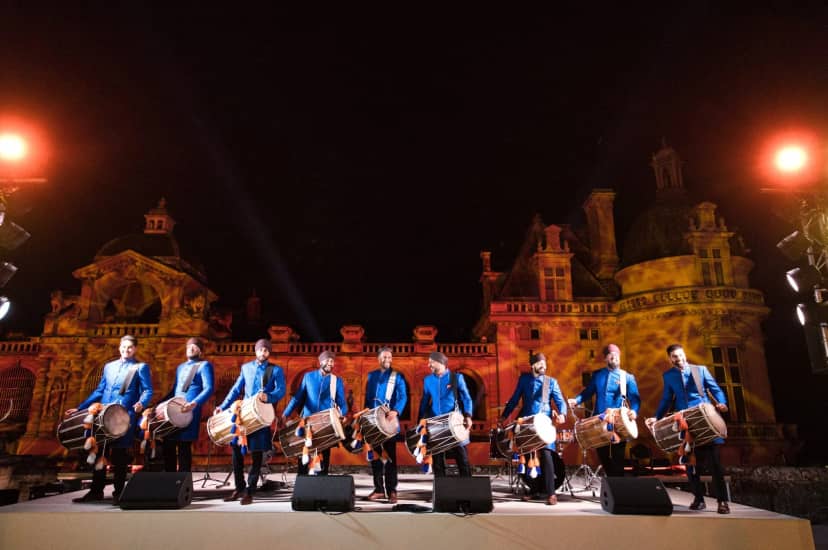
Everything about the dhol drum, from its Punjabi roots to booking dhol players for your wedding. Real advice from a dhol player with 30 years' experience.
The short answer: a dhol is a large, double-headed drum from Punjab, played with two sticks and worn on a strap. It is loud, bright and made for moving crowds. That is why it leads the baraat, announces the couple and fills the dance floor at almost every Punjabi and Asian wedding.
I'm Dav Panesar. I have been playing dhol for 30 years. This guide covers what the drum is, then everything I tell couples before they book.
What is a dhol?
The dhol is a barrel-shaped Indian drum with a skin stretched over each end. It comes from Punjab, which is why you will also hear it called the Punjabi dhol. Because it drives the beat of bhangra, plenty of people simply call it the bhangra drum.
It hangs from the player's shoulder on a strap, so the player can walk, dance and lead a procession while playing.
Two sticks, two sounds
A dhol is played with two different sticks:
- The dagga is the thicker, curved stick. It strikes the bass side and gives the deep thump you feel in your chest.
- The tihli is the thin, flexible cane. It snaps against the other side for the sharp, high crack that cuts through a crowd.
Put the two together and you get the bounce that makes people start dancing before they have decided to.
What is a dholi?
A dholi is a dhol player. You will see both words used. A good dholi does far more than keep time. They read the room, lift the energy and know exactly when to build and when to hold back.
Where the dhol is played
The dhol is at the heart of bhangra, the folk dance that began with harvest celebrations in Punjab. At weddings you will hear it at:
- The baraat, leading the groom's party to the venue.
- The jaggo, the lively night before a Punjabi wedding when family dance through the streets.
- Entrances for the bride, the groom or the couple together.
- The reception, often alongside the DJ.
Dhol or dholki?
People often mix them up. The dholki is a much smaller drum, played with the hands while sitting down. It is the one you hear at the mehndi and sangeet, with family singing traditional songs. The dhol is bigger, louder and played standing up with sticks.
What can you book dhol players for?
At weddings, these are the bookings I see most:
- The baraat. Dhol leads the procession and gets the groom's side dancing.
- The groom's arrival. A big, loud welcome as he reaches the venue.
- The bride's entrance. It works just as well for traditional and modern weddings.
- The couple's entrance at the reception. A strong way to start the evening.
- Reception sets. Playing on the dance floor, on their own or with your DJ.
Dhol is not just for weddings. We also play birthdays, anniversaries, corporate events, launches and private parties. If you already know what you need, you can book dhol players for your date in a couple of minutes.
How much do dhol players charge?
There is no single price, because no two bookings are the same. These are the things that move a quote up or down:
- Experience. Well-known players and established teams charge more. You are paying for their skill, presentation and reliability.
- How many players. Four players cost more than two. That sounds obvious, but the jump is not always double.
- Travel. Long journeys, or an overnight stay, add to the cost.
- Your date. Summer Saturdays and other busy dates are in high demand.
- What you want. An entrance, a baraat, a stage show and a DJ set all need different planning. Matching outfits or a planned routine can add to it.
- Time on site. This is the one most people miss.
Why time on site matters so much
Say you want dhol for your entrance at 7pm, then the same players back with the DJ at 10.30pm. You might only hear them for 30 minutes in total. But they are at your venue for most of the evening and cannot take another job that night.
Compare that with a single entrance, where the players arrive, play and leave in about an hour if things run on time. Same playing time, very different booking.
So when you ask for a quote, give the actual times you want them to play, not just how many minutes. Then check what the quote covers: travel, waiting time, extra sets and anything special you have asked for. If you want typical figures, our dhol player cost guide has them.
How many dhol players do you need?
It depends on the venue, the space and the effect you want. Guest numbers matter less than people think.
- One player suits a small party or a room with little space.
- Two players is the most popular choice. Two drums playing in sync look and sound far bigger than one.
- Four players is for a real statement: a big baraat, a grand entrance or a large ballroom.
- Bigger teams of ten or more, and sometimes twenty, are possible with an established team for very large occasions.
More is not always better. Four drums can look amazing in a big hall and be far too much in a small room with a noise limit. Pick the number for the venue, not the guest list.
DJ and dhol: what makes a great set
Playing alongside the DJ at the reception is one of the most popular bookings. A typical set runs for about 30 minutes, mixing Bollywood, bhangra and English tracks to suit your guests.
The difference between an average set and a great one is big. An average player stands still and drums along. A great one moves through the crowd, plays to the guests and builds the energy track by track. Some can host and get guests involved, a bit like an MC.
Things worth talking through first:
- The music. Good teams have sets for different crowds: Bollywood, bhangra, or English and fusion. Some also bring in hip-hop, UK garage, dancehall or EDM. Not every team plays every style, so ask.
- Mixed-culture weddings. When two families come from different backgrounds, the set needs to work for both sides. This takes real experience to get right.
- Your favourite songs. Most teams play to pre-mixed sets, but you can often fit a couple of your own songs in near the end. Agree this in advance.
- Timing with the DJ. Some couples want the set as the dance floor opens. Others want it later, when everyone is already up. There is no right answer, so plan it with your DJ.
Dhol also works well as part of a bigger show with bhangra dancers, a DJ or an Indian band baja, as long as everyone knows the timings.
My best tip: watch real videos of a team playing to a crowd before you choose. A photo cannot show you energy. You can see our dhol players in action on our main page.
How far ahead should you book?
Book once your date is fixed and you know you want dhol. Teams work on a first come, first served basis, and your players are only held once you pay the deposit.
Some teams have enough players to cover a morning wedding and an evening reception on the same day. Once they are all booked, though, that is it for that date. Busy summer weekends go first.
There is no fixed rule about six or twelve months. If your wedding is only weeks away, still ask. There is often someone free.
What to look for in professional dhol players
These are the five things I would check:
- Experience. Have they played events like yours, and do they understand how the day runs?
- Reliability. Quick replies, clear answers and turning up on time.
- How they look. Dhol players are in some of the most photographed moments of the day. Check their outfits, especially if you want a matching team.
- Real videos. Look at their website, Instagram and TikTok. Watch them with real guests, not just posed photos.
- Genuine reviews. Check Google or Trustpilot for comments on punctuality, professionalism and the performance itself.
Please do not choose on price alone. These moments only happen once.
Dhol at a mandir or gurdwara
Dhol is a big part of Hindu and Sikh wedding celebrations, but the place of worship sets the rules.
At Hindu weddings, dhol often leads the baraat before the ceremony at the mandap. The mandir or venue may still limit where the players can stand.
Gurdwaras need extra care. Some do not allow dhol outside the building or anywhere in the grounds. Sometimes playing is allowed further along the road, with the right permission.
Do not go by what you saw at someone else's wedding. Ask the mandir, gurdwara or venue where and when dhol is allowed before you book.
Planning an outdoor baraat
An outdoor baraat is a brilliant sight. A little planning keeps it that way:
- Weather. Have a plan B for rain.
- The route. Know where it starts and ends, and make sure it works for the family, the players and anything else involved, such as a wedding horse.
- Space. Make sure there is room for the players to play safely among the crowd.
- Venue rules. Some venues allow dhol inside but not outside. Others limit numbers, length or start times.
Real venue restrictions we have come across
Venue rules on dhol can be very specific. These are real examples from weddings we have played:
Froyle Park, Hampshire
Outdoor dhol limited to about 10 minutes.
North Mymms Park, Hertfordshire
No more than two dhol players.
Natural History Museum, London
We were told they were trialling a limit of four dhol players.
Offley Place, Hertfordshire
- No more than two dhol players at any time, whether they are playing alone or with other musicians.
- Jaan or baraat arrivals cannot start before 9.30am, unless the venue team says otherwise.
- No amplified music at all during the arrival.
- A fanfare band is allowed, but the same rules apply: nothing amplified and no more than two dhol drums.
Cut-off times
Many hotels and venues also set a time when drumming has to stop, often because of guests staying overnight. It might be 9.30pm, 10pm, 10.30pm or something else. Your caterer may also have timings that affect the evening.
Before you book, ask your venue:
- Is dhol allowed inside, outside, or both?
- Is there a limit on the number of players?
- Is there a limit on how long they can play?
- Are there places they cannot play?
- What time does drumming have to stop?
Venue rules change, so always check the latest policy with your venue. A good dhol team will already know the rules at the venues they play regularly.
Sound limiters
Dhol is loud. That is the point of it. But some venues have sound limiters that measure the noise in the room.
Depending on the system, going over the limit can cut the power to the DJ's equipment, or turn the sound down. Either way it can stop the party at the worst moment.
If your venue has a limiter, I would usually suggest no more than two players, as long as the venue agrees. Even one player can be too loud for some rooms. Ask the venue if they have a limiter, whether live dhol is allowed and whether it has caused problems before. Sort this out well before the day.
Destination weddings
Yes, UK dhol players can travel abroad for your wedding. I play between 25 and 30 destination weddings a year, with places like Spain, Portugal and Marrakech among the regulars.
There is more to plan, so think about:
- Flights and travel.
- Where the players will stay.
- Luggage for the drums.
- Which days and times you need them.
- Rules at the venue abroad.
- Permission to work and any other local requirements.
- Whether they are needed for one event or several days.
Send us your destination, dates and full plans early so we can work out the arrangements and the total cost with you.
My final advice
There is no one right dhol booking. A small party might need one player. A reception might need two for the entrance and the DJ set. A big baraat might need four or more.
Before you confirm, check:
- The players' experience and how they present themselves.
- Real videos and genuine reviews.
- Exactly what you want them to play, and when.
- How many players you need.
- Your venue's rules.
- How long they will be on site.
- What the quote includes.
- The deposit, payment dates and booking terms.
Get those right and you will have the start to your wedding that everyone talks about. When you are ready, hire dhol players for your wedding through Party Central. Tell us your date and venue and we will come back to you with who is free. Planning in London? See our dhol players in London.
Frequently asked questions
What is a dhol?
A dhol is a large, double-headed drum from Punjab. It is worn on a strap and played with two sticks: the thick dagga for the bass side and the thin tihli for the high side. It is the main drum in bhangra and at Punjabi and Asian weddings.
How much do dhol players charge?
It depends on the players' experience, how many you book, travel, your date and how long they need to be at your venue. Time on site matters most. Give your exact playing times when you ask for a quote.
How many dhol players do I need?
Two is the most popular choice. One suits a small party or tight space. Four makes a big statement at a large baraat or ballroom. Choose based on your venue and its noise rules, not just guest numbers.
Can dhol players perform at any venue?
No. Some venues limit the number of players, how long they play, where they play or what time drumming must stop. Some have sound limiters. Always check with your venue before you book.
What is the difference between a dhol and a dholki?
The dhol is big, loud and played standing up with two sticks. The dholki is a small hand drum, played sitting down, usually at the mehndi and sangeet while family sing.
What is a dholi?
A dholi is a dhol player. The best ones do more than keep the beat. They read the crowd and build the energy at the right moments.
How far in advance should I book dhol players?
As soon as your date is fixed. Teams are booked first come, first served, and busy summer weekends go first. If your event is only weeks away, still ask.
Can dhol players play with my DJ?
Yes. A DJ and dhol set usually lasts about 30 minutes and can mix Bollywood, bhangra and English music. Agree the music and timing with your DJ and the players beforehand.
About the author
Dav Panesar has played dhol for 30 years. He is a co-founder of Elite Drummers, one of the UK's largest dhol teams, playing over 500 UK events and 25 to 30 destination weddings a year. He is also a co-founder of Party Central.
Ready to book dhol players?
Tell us your date and venue. We'll match you with partners who are free.
Book dhol players near you
Dhol Players in LondonDhol Players in BirminghamDhol Players in ManchesterDhol Players in LeedsDhol Players in GlasgowDhol Players in LiverpoolDhol Players in BristolDhol Players in Sheffield
Prices mentioned are starting points only. Exact pricing depends on availability, your exact requirements, time on site and location. Party Central is a trading name of Booking Central Ltd.