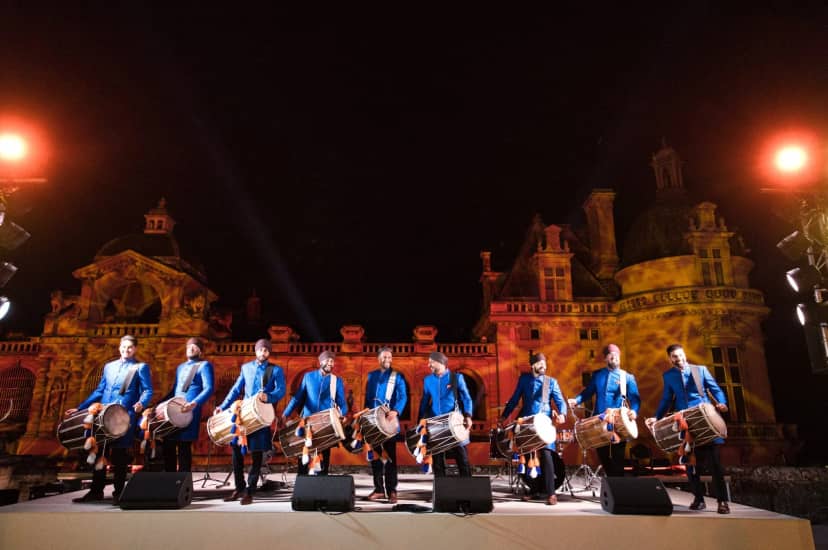
Two dhol players suit most baraats and entrances and work well in venues with sound limits. Four make a bigger impact in a larger room, and bigger teams are for grand stage moments. The right number depends on your venue, your guest numbers and the moment, and our team will help you decide.
Key takeaways
- Two players are the usual choice for a baraat or an entrance.
- Four players are most often booked for receptions, for visual impact and energy.
- Always check what your venue allows before you settle on a team size.
One, two or four: how do you choose?
There is no single right answer, but there are clear patterns.
- One player: smaller, more intimate moments.
- Two players: the most popular choice for baraats and entrances, and a good fit for smaller venues or venues with sound limits.
- Four players: most often booked for receptions, for visual impact and energy.
- Six, eight or more: large venues and stage presence, for the grandest weddings.
Does the size of the room matter?
More than almost anything else. Two players can disappear in a large ballroom, while a big team can overwhelm a small hall.
At the large main room of one London hotel we advise at least four players, and we have previously supplied 14 for a grand performance. For most entrances in an ordinary banqueting hall, two is plenty.
Which moment are you booking for?
A baraat is led on foot, so two players are a good baseline, with more for a long procession or an outdoor start. A bride and groom entrance usually works well with two. A set with your DJ, played to a full dancefloor, is where a team of four really shows.
What do venues allow?
Some venues set a maximum number of players. In our experience, a couple of well-known country house venues allow two, and a London museum has trialled a limit of four to keep sound levels down inside.
Policies change, so always confirm the current rules with your venue before you choose a team size. We check them for you when you tell us where you are marrying.
Can you fit the number to your budget?
A bigger team costs more, but more players is not always better. Tell us your date, venue and budget and we will recommend the number that works for your room. If a bigger team is out of reach, we can often suggest other ways to get the impact you want.
Want a quote for dhol players?
Free, no obligation. Tell us your date and venue.
Frequently asked questions
Are two dhol players enough for a baraat?
For most baraats, yes. Two players lead the groom's party well and suit venues with sound limits. For a long procession, a large family or an outdoor start, more players can lift the energy.
How many dhol players do I need for a bride and groom entrance?
Two is the usual choice and works in most rooms. In a very large hall, four makes the entrance feel bigger. Tell us your venue and we will advise.
Do venues limit the number of dhol players?
Some do. Limits are usually set to control sound levels. Check the current policy with your venue, and tell us where you are booked so we can check as well.
Is one dhol player enough?
One player suits smaller, more intimate moments. For a baraat or a big entrance, most people prefer two.
Not sure how many players you need?
Tell us your date, venue and budget and we will recommend the right team size.
Book dhol players near you
Dhol Players in LondonDhol Players in BirminghamDhol Players in ManchesterDhol Players in LeedsDhol Players in GlasgowDhol Players in LiverpoolDhol Players in BristolDhol Players in Sheffield
Written by the Party Central events team. Prices mentioned are starting points only. Exact pricing depends on availability, your exact requirements, time on site and location. Party Central is a trading name of Booking Central Ltd.