Skip to content

Wedding Entertainment
for Every Tradition

Asian, Muslim, Jewish, English, Scottish, Welsh and destination weddings: acts, music, stages and decor for every part of your day, booked with one team.

Weddings in the UK come in every shape. A Sikh Anand Karaj in the morning and a bhangra-filled reception at night. A nikkah followed by a walima. A ceilidh in a Highland barn, a chuppah under fairy lights, or three days of celebrations on a terrace in Italy. Whatever your traditions, Party Central books the people and the pieces that make the day: musicians and dancers, stages and mandaps, DJs and decor, all arranged by one team that keeps everything on time.

This guide walks through the weddings we plan for, tradition by tradition, with the moments that matter in each one and the acts that suit them. If your wedding blends two cultures, or follows a tradition we haven't covered here, tell us and we'll plan around it. Planning the jaggo, the mehndi or the engagement party? Our private events guide covers those nights too.

01

South Asian weddings

A South Asian wedding is rarely a single day. There's usually a run of events, each with its own mood: turmeric ceremonies at home, a night of henna and dancing, the ceremony itself and a big reception. We plan the entertainment across all of them, so the energy builds from the first song to the last dance.

Male and female bhangra dancers performing on a white dance floor

Punjabi weddings

A Punjabi wedding is loud in the best possible way, and it rarely starts on the wedding day. The jaggo night sees relatives dancing through the house or the street behind a decorated pot of lamps, the maiyan covers the couple in turmeric paste, and the mehndi brings out the giddha and the boliyan, the playful couplets the aunties have been saving all year.

On the day, the baraat arrives to the beat of a dhol, often with the groom on a decorated horse or on the back of a DJ truck. The reception is where the bhangra takes over, and the doli closes the celebrations as the bride says goodbye to her family. Most Punjabi families book a dhol for every one of these moments, then add dancers and a live singer for the reception.

Sikh wedding ceremony inside a gurdwara, the wedding party standing before the golden palki

Sikh weddings

The Anand Karaj takes place in the gurdwara, usually in the morning. The couple walk around the Guru Granth Sahib for each of the four laavan while the hymns are sung, with the bride's family guiding her round. It's a calm, devotional ceremony, so the celebration happens around it: the milni as the two families meet and embrace, the baraat's arrival with dhol outside, and the reception later in the day.

Every gurdwara has its own rules about music, timings and dress, and we plan around them. Performers keep to the times and the spaces your gurdwara allows, and the big entrance, the bhangra and the live music move to the reception. Turban tying for the groom's party on the morning, a wedding horse for the arrival and dhol players outside the gurdwara are the classic Sikh wedding bookings, with photographers who know when to stay out of the way.

Carved gold pillared mandap with floral canopy and a long white aisle

Hindu and Indian weddings

A Hindu wedding is built around the mandap, where the couple sit by the sacred fire, exchange garlands in the jaimala and take the pheras around the flame while the priest leads the mantras. Many families also hold a Ganesh puja to bless the week, a haldi morning of turmeric and laughter, and a sangeet night of music and dance, so there's plenty to plan beyond the ceremony itself.

We can arrange the mandap and the wedding stage, Indian wedding decor to match your colours, sitar and tabla players for a gentle ceremony soundtrack, an Indian band baja for the baraat and Bollywood dancers to open the sangeet or the reception. Regional customs vary a great deal, so tell us where your family is from and we'll plan around it.

Band baja in red sherwanis leading the groom's party with coloured smoke

Gujarati weddings

Gujarati families bring their own rhythm to the wedding week. Garba and dandiya raas nights fill a hall with great circles of dancers, sticks in hand, turning faster as the music builds. The groom's party, the jaan, is welcomed at the venue with music, and the bride's mother greets the groom with the ponkhana, a playful attempt to catch his nose. The ceremony follows the Hindu rites under the mandap, with the hasta milap joining the couple's hands.

A DJ who knows the garba catalogue inside out, live singers and the pulse of a dhol keep the circles turning late into the night. For the jaan, an Indian band baja in matching jackets leads the groom in with brass, drums and plenty of coloured smoke.

Gold carved mandap with ivory chairs and floral displays

Tamil weddings

A Tamil wedding is timed to the minute, with the thaali tied at the muhurtham, the auspicious hour, which often falls early in the morning. Rituals such as the kashi yatra, the garland exchange and the oonjal, where the couple sit on a swing while relatives sing and circle them with coloured rice balls, sit alongside a colourful reception later in the day. Many families keep the sound of the nadaswaram and thavil for the ceremony itself.

We help with the mandap and the stage, the decor and flowers, the photography and the reception entertainment, and plan every arrival and set-up around your priest's timings, so nothing runs into the muhurtham.

Close-up of an Asian bride wearing a maang tikka and nath with a red dupatta

Bengali weddings

Bengali weddings, Hindu and Muslim alike, often begin with the gaye holud, a turmeric ceremony full of colour, songs and laughter, usually held at home or in a hall dressed in yellow and marigold. Hindu Bengali couples share the shubho drishti, the first look as the bride lowers the betel leaves from her face, and the mala bodol, the exchange of garlands, while the conch shells sound and the women's ululation fills the room.

We plan decor, stages and music for each event, from a relaxed holud at home to a grand reception, with photographers and videographers who know the moments not to miss.

Mehndi seating with colourful floor cushions, drapes and carved elephants

Pakistani weddings

Pakistani weddings usually run across several events, each with its own feel and often its own venue. Dholki nights bring the family together for songs around the dholak, and the mehndi follows with rehearsed dances, bright colours and plenty of good-natured rivalry between the two sides. Then come the baraat, the nikkah and the rukhsati, when the bride leaves with her new family, and finally the walima, hosted by the groom's side.

Popular bookings include dhol players for the baraat, a nikkah stage and a walima stage, Asian wedding DJs who can move from qawwali to the latest Punjabi tracks, and colourful mehndi decor with cushions, swings and drapes. We plan every event with the same team, so the week hangs together.

Curved backlit stage with gold sofa

Bangladeshi weddings

Bangladeshi weddings in the UK often bring together the gaye holud, the nikkah and a walima reception, with the whole family involved at every step and guests travelling from across the country. Many are alcohol free, and some keep separate spaces for men and women, so the entertainment is planned around your family's wishes rather than a standard running order.

The stage is the centrepiece of a Bangladeshi reception, where the couple sit to greet every guest, so it's worth getting right. A nikkah stage, a walima stage and matching decor are the usual starting points, with photographers and videographers to capture the family portraits, which can take a good part of the evening.

02

Muslim weddings

Muslim weddings across the UK draw on many cultures, from South Asian, Arab and Turkish families to Somali, North African and convert couples. Most share two moments: the nikkah, the marriage contract, and the walima, the celebration that follows. We plan both with care for your family's customs, from the music you'd like (or not) to how the room is laid out.

Floral arch stage at a community hall

The nikkah

A nikkah can be small and intimate, at a mosque or at home, or the centrepiece of a beautifully dressed venue. The imam leads the ceremony, the couple give their consent before their witnesses, the mahr is agreed and the contract is signed, often followed by a short sermon and a dua for the couple's life together.

A nikkah stage gives the couple, the imam and the witnesses a calm and elegant setting, with seating, florals and backdrops styled to your colours. Many couples add soft lighting, a separate signing table and decor for the hall, and book photographers who understand when to stay discreet. If the nikkah and the reception share a day, we plan the changeover so the room is turned round without fuss.

Floral wall stage with a white carpet aisle

The walima

The walima is the groom's family's celebration, and it can be as grand as you like. It's a chance to welcome the new couple into the family, with a feast, speeches and plenty of photographs. Many walimas are alcohol free, so we plan entertainment that lifts the room without relying on a bar.

String quartets or a Bollywood string quartet for the arrival, a walima stage for the couple, caricature artists and magicians to keep guests entertained between courses, and a photo booth for the family pictures all work beautifully. For a sweet finish, custom ice creams and a dessert table go down well with every age.

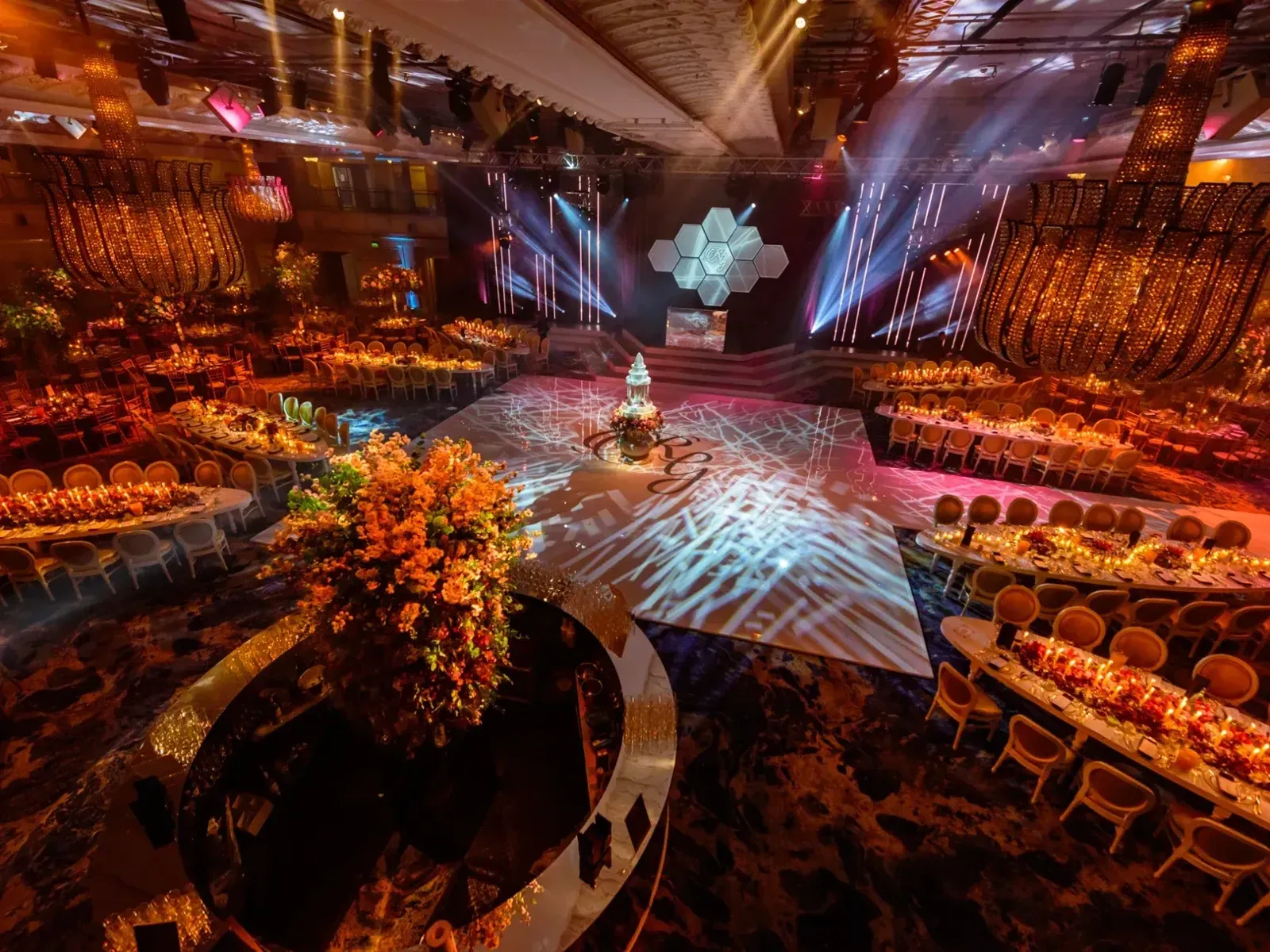
Ballroom with pink lighting and a printed dance floor at Fairmont Windsor Park

Arab, Somali and Turkish weddings

Arab weddings often open with a zaffe, a drummed and danced procession that leads the couple into the room, followed by a long night of dabke, music and food. Somali weddings bring the dhaanto and days of aroos celebrations, with bright dirac dresses and a crowded dance floor. Turkish and Kurdish weddings have their henna night, the kına gecesi, and the halay, a line dance that can stretch the length of the hall.

Whatever the tradition, the room matters: a stage for the couple, lighting and sound that suit a big hall, a DJ who knows the music and decor in your colours. Some families also book belly dancers for the reception. Tell us about the moments that matter to you and we'll plan around them.

03

Jewish weddings

A Jewish wedding moves from the quiet of the bedeken and the signing of the ketubah to the joy of the chuppah, the breaking of the glass and the cheer of "mazel tov". Then the hora begins, the couple are lifted high on chairs, and the party rarely slows down.

Pink floral backdrop with ivory drapes

Under the chuppah

The chuppah is the heart of a Jewish ceremony, a canopy that stands for the home the couple will build together. It can be traditional or modern, draped in fabric, hung with greenery or covered in flowers. Before it comes the bedeken, the veiling of the bride, and the signing of the ketubah; under it, the blessings, the rings and the breaking of the glass.

We can supply the chuppah and the decor around it, and arrange string quartets, harpists or violinists for the walk down the aisle and the signing. Weddings are usually planned around Shabbat and the Jewish calendar, so tell us your date early and we'll check who's free.

Guests dancing with the band in the middle of the crowd

The hora and the party

Once the glass is broken and the cheers of "mazel tov" die down, the music takes charge. The hora comes first, with the couple lifted high on chairs, then Israeli dancing, the mezinke for parents marrying off their last child, and a mix of classic and modern tracks that keeps every generation on the floor.

A wedding band or DJ who knows exactly when to break into the hora makes all the difference. Add a toastmaster to run the speeches and the courses, a photo booth for the late-night crowd and a mobile bar, and the party rarely slows down.

04

Weddings across England, Scotland, Wales and Ireland

From country house ceremonies to Highland ceilidhs, the four nations each bring their own customs to the day. Here's how we help couples make the most of them.

Saxophonist and two guitarists playing in a garden at dusk

English weddings

An English wedding often follows a familiar shape: a church or civil ceremony, a drinks reception on the lawn while the photographs are taken, the wedding breakfast and speeches, then the cake, the first dance and an evening party. Country houses, barns, hotels and marquees are favourite settings, and each part of the day suits a different kind of entertainment.

We book string quartets and harpists for the ceremony, a jazz band, an acoustic trio, a magician or living statues for the drinks reception, a toastmaster to keep the day on time, and a wedding band or DJ for the evening. A photo booth and a mobile bar keep the party going once the dancing starts.

Band members playing on a packed dancefloor

Scottish weddings

Scottish weddings have a character all of their own. A piper leads the guests in or plays the couple out, kilts and tartan fill the photographs, and the couple may share a dram from the quaich or bind their hands in a handfasting. Scotland is also known for its outdoor ceremonies, from beaches and lochsides to castle lawns, and for weddings that keep going long after the speeches.

The evening usually ends in a ceilidh, with a caller guiding every dance so that nobody needs to know the steps. A live band with a fiddle and an accordion in the line-up, singers for the ceremony and a wedding band or DJ for the late set are the usual mix. Tell us about your venue and we'll plan the music to suit.

Singer performing to the crowd from an outdoor stage

Welsh weddings

Welsh weddings are full of song. The harp is the national instrument of Wales, so a harpist for the ceremony feels just right, and many couples choose bilingual vows or a reading in Welsh. Love spoons, carved by hand with symbols for the life ahead, make a meaningful gift, and a soloist can bring the whole room to its feet as you walk in.

We can arrange harpists, singers and string quartets for the day, and an evening wedding band to carry the singing on, whether you marry in a chapel, a castle or a barn in the hills. Many Welsh couples also love a hymn or two in the ceremony, so we'll make sure the musicians know them.

Violinist and two guitarists playing to guests on a waterside terrace

Irish weddings

Irish and Northern Irish weddings are known for their warmth and their stamina. Traditional music, a Claddagh ring, a blessing or two and, often, a few steps of Irish dancing set the tone, and the party regularly runs well past midnight, with a late supper to keep everyone going. Church ceremonies are common, so the music there follows the church's guidance and the celebration really begins at the reception.

A live band with a fiddle in the line-up, a violinist for the drinks reception, a wedding band for the floor fillers and a DJ to finish are the usual choices. If you'd like a trad session or a singer for a favourite song, tell us and we'll find the right people.

05

African and Caribbean weddings

African and Caribbean weddings in the UK are some of the most joyful celebrations we plan, with big entrances, big music and a packed dance floor from start to finish. Many couples celebrate across two days, and each needs its own plan.

White arched stage set with moving lights and a printed monogram dance floor

Nigerian and West African weddings

Many Nigerian and Ghanaian couples hold a traditional wedding with the two families before the white wedding, each with its own outfits, rituals and music. At a Yoruba engagement the groom and his friends prostrate before the bride's family; at an Igbo wedding the bride searches the crowd to bring her groom a cup of palm wine. Guests coordinate in aso ebi, the couple make a grand entrance, and money is sprayed on the dance floor as the Afrobeats and highlife play.

We book DJs who know the music, live bands, comperes and MCs to keep the energy high and the programme moving, and the stage, lighting and decor for both days.

Saxophonist performing under purple party lighting

Caribbean weddings

Caribbean weddings bring the sunshine with them, whatever the British weather. A steel band for the drinks reception is a favourite, followed by soca, reggae, lovers rock and calypso into the night. The black cake, rich with soaked fruit, takes pride of place on the sweet table, and the speeches are often as lively as the dancing.

A DJ or a live band who can read the room, a sax player to play over the DJ's set, catering and a mobile bar complete the picture. Families often bring traditions from more than one island, so tell us yours and we'll plan the music to match.

06

More traditions we plan for

Britain is home to communities from all over the world, and their weddings are part of what makes our work so varied. A few more we plan for regularly:

Band singers performing among dancing guests

Greek and Greek Cypriot weddings

At a Greek Orthodox wedding the koumbaros exchanges the stefana, the wedding crowns, over the couple's heads, and the newlyweds take their first steps as a married pair around the altar in the dance of Isaiah. At the reception guests pin money to the couple during the first dance, napkins fly through the air in place of the old plate smashing, and the night ends with the syrtaki and the tsamiko.

A live band with Greek songs in its set, singers who can lead the room and a DJ for the late hours keep the circle dancing going, with a mobile bar for the toasts.

Sax and trumpet players dancing among wedding guests

Polish weddings

Polish weddings begin with the couple welcomed by their parents with bread and salt, and build through a long evening of food, toasts and dancing to the oczepiny at midnight, when the bride's veil comes off and the games begin for the newlyweds and their guests. "Sto lat" is sung more than once, and some families carry on with the poprawiny, a second day of celebrations.

We book wedding bands, DJs and MCs who can run the games, keep the dance floor full and switch between Polish favourites and the songs everyone else knows.

Crystal stand with roses under purple lighting

Chinese weddings

Chinese weddings often include a tea ceremony to honour the elders, playful door games on the morning as the groom earns his way to the bride, and a banquet of many courses dressed in red and gold for good fortune. The couple may change outfits through the evening, and the toasts of "yam seng" grow louder each time.

We can help with the decor and the stage, photography, a string quartet or pianist for the banquet and magicians who work the tables between courses. If you're planning a lion dance for the arrival, tell us its timing and we'll plan the rest of the entertainment around it.

Violinist in a lehenga in a pillared garden walkway

Civil, humanist and same-sex weddings

Whether you marry at a register office, a licensed venue or with a celebrant in a meadow, the ceremony can be as personal as you want it to be. Humanist and celebrant-led ceremonies in particular leave room for your own words, readings from friends, handfastings and music chosen just for you.

We plan music for the walk down the aisle and the signing, from a harpist or string quartet to a solo singer or violinist, and the entertainment for every part of the day after it. Every couple is welcome, and every booking is planned around the two of you.

Violinist performing on a festival stage between two dhol players

Fusion and multicultural weddings

More and more couples bring two cultures together: a church service in the morning and a sangeet at night, a nikkah and an English reception, or a Sikh ceremony followed by a Caribbean party. The best fusion weddings give each tradition its own moment rather than blending everything into one, so both families feel at home.

We plan acts for both sides of the family, from a string quartet at the ceremony to dhol players for the evening entrance. A Bollywood string quartet or a Bollywood fusion band can play both worlds in one set, and a DJ who knows both playlists brings everyone together on the floor.

Couple embracing under old stone arches while passers-by blur past

07

Destination weddings

Marrying abroad is a big part of what we do. Couples take their families to the sun, to a chateau or to a palace, and they want the same dhol, the same bhangra and the same atmosphere they'd have at home. Our performers travel with your wedding, so your traditions come with you wherever you say your vows, and one team looks after the bookings from the first enquiry to the last dance.

  • Where couples are marrying

    Europe is the favourite, from the lakes and hills of Italy to Spain's Costa del Sol and the Balearics, Portugal's Algarve, the chateaux of France and the islands of Greece and Cyprus. Further afield, couples choose Turkey, Marrakech, Dubai, the palaces and beaches of Udaipur, Jaipur and Goa, Thailand and Mauritius. Wherever you're heading, tell us the venue and we'll plan the entertainment around it.

  • Taking your traditions abroad

    A baraat on a sea-view terrace, a mehndi by the pool or a sangeet in a courtyard all need the same care as they would at home, plus a little more. Our dhol players, bhangra dancers and DJs travel with their instruments and kit, and we check the local rules that catch couples out: noise curfews, limits on processions, open flames and the times a venue allows music. We also plan mandaps, nikkah stages and decor with your venue and your planner.

  • How a wedding abroad comes together

    Share your destination, your dates, the venue and roughly how many guests are coming. We check which acts are free and able to travel, then send one quote with travel included. From there we work with your planner and the venue on timings, rehearsals and set-up, so on the day the music starts exactly when it should and you can enjoy every minute.

08

Planning your wedding entertainment

However you celebrate, a little planning makes the day flow. These are the questions we help every couple answer.

  • Timing the day

    Think of the day in parts: the arrival, the ceremony, the drinks reception while the photos are taken, the meal and the speeches, then the evening party. Each part suits a different kind of act. Calm music for the ceremony, something to watch during the drinks and high energy for the evening is a simple rule that works for almost every wedding.

  • Venue rules worth checking

    Ask your venue about noise limiters and finishing times, whether a dhol or a live band can play indoors, the rules on fire acts, confetti and smoke, access and set-up times, and the power available for a DJ or a band. If your ceremony is at a place of worship, ask about its rules on music and dress too. We check these details with your venue before the day.

  • When to book

    Summer Saturdays and the busiest weeks of the Asian wedding season go quickly, so book your key acts as soon as you have your date. It's never too late to ask, though: tell us what you need and we'll find the best options that are still free.

Ready to book?

Tell us your date and we'll send you every option that's free. No obligation.

Booked in three simple steps

How It Works

  1. Tell us about your event

    Pick a service, add your date and venue. It takes about a minute.

  2. Get matched and quoted

    We match you with vetted performers and suppliers who are free on your date and send you options.

  3. Book and celebrate

    Confirm your booking with our team. We stay your single point of contact up to the big day.

Bride and guests dancing to a live band

Frequently asked questions

When do acts usually perform at a wedding?

Most couples book acts for the drinks reception, while photos are taken, and for the evening party. We plan around your timeline.

Can performers match our wedding colours?

Often, yes. Living statues and champagne walkers can usually be styled to your palette.

Do you work with gurdwara, mosque, temple and synagogue rules?

Yes. Every place of worship has its own rules on music, timings and dress. Tell us where your ceremony is and we’ll plan the performers and the set-up around them, with the bigger moments saved for the reception.

Can you plan the entertainment for a wedding that runs over several days?

Yes. Many Asian weddings run across a mehndi, a sangeet or dholki nights, the ceremony and a reception. We plan every event with the same booking team, so the acts and the timings fit together.
Can your performers travel abroad for a destination wedding?

Yes. Our acts travel to weddings across Europe and further afield. We include travel in your quote and plan around the venue’s rules and any local curfews.

Can you mix traditions for a fusion wedding?

Yes. Tell us the traditions you’re bringing together and we’ll suggest acts for each part of the day, from a string quartet at the ceremony to dhol players for the evening entrance.

Guests dancing under coloured lights at a party

Looking for something special?

Browse every service we book, from DJs and live bands to magicians, dhol players and showstopping acts.